Search

Fridays with Phil

Life, family and unshakeable faith

Category

Uncategorized

Where’s my healing?


Sometimes I sound more together than I really am.  There are days it takes all my grit to keep living with hope and not default to focussing on my own pain, whinging all the while, or trying to escape it even just for a moment.

I don’t want to die and I don’t want to miss out on a thing.

That said, I am well aware that my pain could be another’s gain. I wonder in your life if your pain could become someone else’s gain.

We can choose to try and run from our pain or we can choose to embrace it and take the view that even in our suffering, maybe others can benefit.

This week at the Australian Open tennis, a commercial was aired [via http://www.curemnd.org.au].  It starred tennis players bringing awareness to the MND/ALS disease and the need to find a cure.  I love that!

Some say that MND is incurable but it’s not, we just haven’t found the cure yet.

I know it’s easy to fall into the trap of thinking of ourselves when we go through difficult times, but if we can move beyond that, the potential to help others is enormous. 

For me, that looks like doing whatever I can do to not only seek my own healing, and not only dwell on my prognosis, but also, to wholeheartedly support the quest to find a cure.

It’s not unique but it can be hard.  I see people all over the world deliberately putting the needs and safety of others before themselves even when I’m sure they have their own issues to deal with.

Most people with MND today realise that the cure may not come in their lifetime but what they do today could indeed save the lives of thousands tomorrow.

Like many diseases that were once incurable, a cure starts with awareness, that brings funding, that provides research.  And dare I say it:  our attention depends on the number of people the disease kills and who those people are.

So yes, while there are days I wonder “where is my healing?” I am more likely thinking about how good a cure would be.

I don’t think the discovery of a cure is any less a miracle and gift from God than what can and does take place in an individual’s life.

When I see doctors in third world countries operating on the blind through removing cataracts, it’s a cure but it is also a miracle for the person who can see again.

When I witness children who are infected with H.I.V. surviving through medicine, it is miraculous.

I get excited when through medicine, counselling, surgery, and science, things that were once impossible become possible.  It blesses me to see mankind trusting God to show them His mind on things and where disease once stole life, now millions can experience wholeness.

Just this week I read that according to The Lancet, in Australia 86 per cent of people with breast cancer are still alive five years after diagnosis.  This is thanks to more funding allowing for more research and early detection.

In our waiting and in our suffering, let’s always remember that there is someone else we could help, there is a cause we could further, a hand we could lend.

Waiting with you,
Phil

 

The stupid things I’ve said

When I was diagnosed with Motor Neurone Disease (MND), I noticed that people didn’t know what to say and even close friends struggled to communicate with me.

I know how they feel, as I have been there myself, wanting to offer words of comfort to others but not knowing what to say.

So here are a few things my experience has taught me that may help you communicate with those who are struggling. It may be a terminal illness like me, or it may be a dream not yet realised, a broken relationship, or a dead-end.

A classic comfort we offer others is to compare their situation to those who are seemingly worse-off. For example, some have said to me, “well you could have been hit by a car and already be dead”. I get the premise, but in reality, this has offered no comfort.

I have heard of others who have lost a child or spouse and were told they should at least be thankful for the short time they had together. This is something only they have the right to say. When you feel like your world has just ended, there are better things that could be said.

Comparing to a “worse” event brings little comfort.

Another classic: “there must be a reason for this because everything happens for a reason”.

The problem with this is often it is impossible to figure out a reason why someone is experiencing a tragedy that has derailed their hopes and dreams and impacted their family and finances.

Whatever you do, don’t suggest that the reason is that it could be God testing them. This is hard for me to fathom. The God I love and know would not and does not reward those He loves with life’s harshest conditions, like poverty or a terminal illness.

Yes, maybe in the midst of the challenge we can give what is happening to us some meaning but that’s a very personal thing that no one else can assume on the sufferer.

My hope is that anyone who is suffering would ultimately be able to give what they are going through a sense of cause and purpose, as I have experienced, even while going through the valley.

In the same vein, to those searching for something to ground tragedy in, I have heard it said or inferred, “maybe its because of something you have done.”

This old chestnut suggests that bad things happen to those who have done something to deserve it.

I’m sure we can all recall areas of our life that are far from perfect so when tragedy does come, it’s not hard to blame yourself or think that maybe somehow you deserve it.  I’ve been there, and I recommend getting out quick because it’s a dead-end.

Christ came to bring grace, He stood in the gap, and where we deserved death for our sin, He offers life.

Sure, there are consequences for all our actions: we’ve all heard it said, the smoker increases their risk of getting cancer, and the overeater increases their chances of getting heart disease.  However, we should never think that an undeserved or tragic circumstance in life is some sort of divine punishment.

The good news of the Gospel is that God is a God of grace not of karma.

They are a few things I won’t be saying, now, these are some great things I have experienced:

  • I’m washing my car this weekend and I’m coming to wash yours as well!” – Be specific when offering to help.
  • Boy you look so tired today, are you ok?” – Be real, don’t lie.
  • I’m coming over to mow your lawn, no need to come out, just wanted you not to worry when you hear the mower?” – Show kindness, expect nothing in return.
  • Hey, I know this is serious and you could die but I’m in this battle with you.” – Acknowledge how bad it is but give your support.
  • I’m so sorry” – Acknowledging loss can be as simple as that.
  • “I love you”, “Thank you”, “I appreciate you”, “I am praying for you” – Waste no time saying the things that matter.

So when we don’t know what to say, let’s err on the side of just being there, and putting ourselves in the shoes of the sufferer before we speak. This is love.

Phil

A simple thank you

I have discovered something about thankfulness, and it’s this:  the more thankful I am, the more thoughtful I am.

For many of us, our default isn’t to think about how our life affects others, how our words lift or wound, how our actions impact our “neighbour”.

But we’re meant to, it’s how we are created to thrive.  We are at our best when we love others as we love ourselves.

So how does thankfulness make me more thoughtful?

In my life, I have noticed that each time I thank God for being able to walk, I am drawn to pray for those who for the first time will be placed in a wheelchair and never be able to walk unassisted again.

When I thank God for my meal, it triggers thoughts of those that have no food, or those who require a feeding tube and don’t get to taste different flavours.

Thankfulness is a tremendous trigger for praying for others.  It’s a springboard that launches me beyond my selfishness and towards empathy – to care, offer a kind word, or do a good deed.

The Apostle Paul gets it, he writes in Philippians 1:3-4, “Every time you cross my mind, I break out in exclamations of thanks to God. Each exclamation is a trigger to prayer. I find myself praying for you with a glad heart.”

Amazing.  Perhaps at the root of selfishness is an ungrateful heart.  Perhaps a disregard for what we have breeds contempt and dissatisfaction with this very day God has graced us with.

When we are not thankful, we are not fully aware of what we have and we become unaware of the needs of others.

Thankfulness and gratitude develop thoughtfulness and compassion for others as we appreciate what we have.

I visited a man this week who had a teaching/research position at Macquarie University for 6 years, 20 years at the University of New South Wales, and 4 years at the University of Newcastle.  A Senior Lecturer on Earth Science, he travelled the world climbing and studying volcanoes.  He was married in 2013 with no diagnosis of MND.   Today he cannot move his legs or arms, confined to a wheelchair and is only barely able to talk, quickly losing this gift as well.

As I thank God for the slow progression of the disease within my own body, I cannot help but be thoughtful about those who are suffering much worse.

When you thank God for what you have in life, it triggers a prayer for those who don’t have and that in turn causes compassion to rise up, insisting we do something about other’s needs.

Why don’t you try thanking God for what you have and see where it leads in praying for others?

When thanking God for your marriage, it may lead to you pray for your spouse.

When thanking God for your children, it may lead you to pray for their future.

When thanking God for freedom, it may inspire prayer for those who are in prison simply because of their faith.

When we are unaware of what we have, we are also unaware of what others don’t have.

I’m not thankful for MND in my body but I try to be thankful in the midst of my MND.  Sure there are moments when I grieve what I can no longer do, but I try to keep them to moments and short ones at that, whilst focusing on what I do have and can do.

What are you thankful for today and where will it lead you…to thoughtfulness?

Phil

P.s. This year’s “Walk-to-defeat-MND” will be held on February 15th.  I would usually start my own page to raise money for this initiative, however this year I am asking those who would like to, to donate as part of “Phil’s Team” to these guys: https://give.everydayhero.com/au/paddle4mnd

8 of Lake Macquarie’s professional beach lifeguards are setting out to challenge themselves on a 130km board paddle from their own Blacksmiths Beach to Sydney’s Bondi Beach. 100% of the money they raise will be going straight to the MND research and awareness. 

The 8 Lifeguards that will be paddling are Lucas Samways, Danny Napper, Rory Chapman, Luca Chapman, Rory Tanner, Sam Earp, Jake Ingle, and Troy Ham… legends!!

Know it all?

163864_135323826530410_2342770_n (3)

Knowledge is a wonderful thing but the right response to knowledge is a better thing: wisdom.

I would say that most of my mistakes have happened, not through lack of knowledge, but how I used the information I had.

For example, when I was managing Kmart in Blacktown many years ago, I was chasing a man who stole goods from the store.  I knew he had run up the stairs of the car park and so I followed him.  When I approached him, he grabbed me and tried to throw me over the edge of the three storey car park. Fortunately others saw and pulled him off.  I knew where he had gone but I was foolish in my response to this knowledge.

Our response to knowledge is the difference between wisdom and foolishness.

What knowledge or truth do you have today that requires you to act and respond well?

You may know that someone loves you deeply but your response to that love is to take advantage of it, to continually test it and manipulate it for your own end.  That is foolishness.

Without right response, knowledge is a dead-end.

Even the Apostle Paul in talking about how God is kind and merciful (i.e. knowledge) says, just because He is, doesn’t mean we should act as fools and test him (i.e. response). Romans 6:1-2 says, “What shall we say then? Shall we continue in sin that grace may abound? Certainly not!…

I have many friends with MND (also known as ALS) who all have the same knowledge about this disease available to them but their responses have varied.

For example one of the symptoms of MND is losing the ability to swallow and therefore being eventually unable to eat food.  The answer to this from a medical platform is to have a PEG attached to your stomach so that you can get food directly to your stomach via a tube.  The problem is you need to get this attached months or even years before you need it or your body is too weak to have it attached.

I have seen people say “no” to the tube for many months then change their mind and say “yes” only to be told its too late.  They responded, but the timing wasn’t right.

It challenges me on how important the right response to knowledge really is, it could even be the difference between life and death.

In your life, it could mean saying “no” to something you have said “yes” to, or it could be saying “yes” but at a different time.

Procrastination is usually loud.  Doing nothing is often talkative.

Whereas, wisdom is active, it is sure and it is often quiet.

I like this quote: “We can be knowledgeable with other men’s knowledge, but we cannot be wise with other men’s wisdom”  ~Michel de Montaigne.

I believe wisdom is ours for the taking if we master our response to knowledge.

Phil

The Dirty Truth

Look around you. Everything you see came from the raw materials found in dirt.

You’re sitting on, living in, driving and eating a product of dirt.

When we look closely at dirt, we find many things: manure, air, moisture, dust, nutrients, hard things, rocks, minerals and resources.

To us, dirt is something we want to wash off straight away.  In its rawness, we often don’t see its potential or beauty. It’s just a pain and an inconvenience.

Dirt is messy.  Likewise, our world is not perfect and neither are our lives. They can be messy.

One thing we can count on this New Year is that dirt will appear in our lives.

Our first reaction will be to want to wash it off and get rid of it. But, let me encourage you, God can take our dirt, what we see as inconvenient, even painful, and make something beautiful with it.

In fact, consider this – humanity originated in the dirt!

The Bible in Genesis 2:7 says, “God formed Man out of dirt from the ground and blew into his nostrils the breath of life. The Man came alive—a living soul!”

Isaiah, a prophet of old, said we are like clay on the Potter’s wheel, in the Potter’s hand.

So, don’t be so quick to remove the dirt from your life before God gets a chance to show you His handiwork.

God can take our imperfect, messy and muddy lives and show His genius and masterpiece.

He is famous for making beauty out of ashes, creating life from dirt.

Corinthians. 4:7 says “But we have this treasure in earthen vessels, that the excellence of the power may be of God and not of us.

We are earthy and imperfect vessels carrying hope and God’s light to a messy world.

Our prayer this year, from the imperfect to the Perfect, may simply be, “Take this dirt and let it live, let it carry Your presence and breath Your excellence on it.”

You see, we all have cracks, we all have hard pieces and dead things in us. Dare I say, we all have smelly manure in our lives.  It is humanity’s common factor.

None of us are perfect. No matter how hard we try, we never will be.

If we allow others to see our imperfect lives, it may just be what God uses to let them see that God is not looking for perfection.

Allow your imperfections to be a means to connect with others who also know they are imperfect.

In doing so, we release the light of God through our lives. We could very well inspire faith in others. Our cracks could reveal the treasure of Jesus’ perfection and excellence within.

Something worth sharing.  Someone worth seeing.

Phil

Enough is enough

If you’re anything like me, you probably came to the point over the course of Christmas day where you had had “enough.”   Even if you were offered one more slice of meat, one more chocolate, or one more drink, you couldn’t do it.

When you have had “enough”, it can be a very satisfied feeling, there’s a fullness to it.

I encourage you, even just for a day, contemplate the fact that you are enough.

Enough change has taken place this year, enough growth and stretching, enough personal bests, enough reaching above and beyond where you have ever been before, and enough striving.

Be satisfied in you.

New Year’s resolutions can wait, what you may be or could become in the future will have their time.

Take a moment or two to rest in all you’ve done and all you’ve become, and who you are right now because you are “enough”! You are lovable, loving, kind and generous, trustworthy, and unique in your own skin.

Psalm 4:6-8 says, “Why is everyone hungry for more? “More, more,” they say. “More, more.”  I have God’s more-than-enough, more joy in one ordinary day than they get in all their shopping sprees.  At day’s end I’m ready for sound sleep, for you, God, have put my life back together.”

Even beyond today, consider the fact that God can use whatever state you are in right now to outwork His purposes.

You may think you need to be more for God to use you but God specialises in the “enough”.

Look at the boy in the Bible with the two fish and five loaves. Everybody else thought it wasn’t enough to feed thousands of people, but it was.  We read in Mark 6 that Jesus took that offering, looked up to heaven and blessed it.

God takes our “enough”, blesses it, and causes the miraculous to happen.

When we come to the place of realising that we are enough, offer ourselves to God to be a blessing, He takes who we are and uses it for good.  You are His “enough” right now and it is amazing what God can do with your “enough”.

So, enough from me 🙂  Go and enjoy being you, just the way you are!

Phil

Tell me why I shouldn’t fear

I was saddened along with so many others this week as we witnessed the horrific situation unfolding in Sydney, hostages held and two killed. Then in the same week, 132 children tragically massacred in Pakistan.

This is frightening and disturbing any time of the year, let alone at Christmas.

The rawness of life and death draws you towards issues of substance, humanity, faith and meaning like little else.

I wonder what your reflections over the past week produced in you? We all felt something.  Was it fear, hope, compassion, hate?

Could it be possible that we produce in our life the fruit of what or who we worship?

If the object of our worship is materialism, selfishness, or an angry, vengeful god, then we don’t need to look much further to find that fruit outworked.

However, if we truly know God, we find ourselves familiar with a loving, peaceful and kind divinity and in the same way, that will bear fruit in our lives.

If the fruit of your faith produces fear in you or others, then I would suggest it is not a faith that promotes the heart of God towards humanity.

Christmas reveals to us a facet of who God is! When we refer to Christ as “Emmanuel”, it means “God with us.”

Jesus came to us as depicted in the Christmas story to reveal to humanity who God is.

The Good News in a nutshell is this, “Fear not, for behold, I bring you good news of a great joy that will be for ALL the people.” (Luke 2:10).

There’s no question the message that God sends to us through His Son Jesus is one of peace on earth and goodwill towards ALL humanity.

Jesus talked about love, but more importantly reveals the power of that love in our lives. He exhibited that love by forgiving His own enemies even as He was hung on a cross.  It was personal.

The promise of Jesus and message of Christmas is both universal and personal.

In knowing Him and in turn, being like Him, our personal responsibility is to love and be peacemakers.

Peace between man and God is the primary reason for Jesus coming to earth: not fear, not hate, not selfishness.

The Bible says that perfect love casts out fear. So the answer to fear and the presence of peace is the love that comes from God.

When social media shared the phrase “I’ll ride with you” this week, I believe it reflected the heart of the God I know.

No cultural or religious divide can separate a man or woman from God’s love, and in knowing God, nor will it separate another from mine.

This has to be the message that resounds loud and clear to a world that is at times held in the grip of fear: “God loves you and so do I”.

I don’t think we can hear it enough. I don’t think we can demonstrate it enough.

What is your response to God’s love this Christmas?

Phil

Let me also take this opportunity in wishing all my readers across 106 countries a very happy, joyful and safe Christmas.

If you have suffered loss this past season, in your tears and grief may you find the ever-present comfort of God. My prayers are with you.

And if you’re looking for a Church to celebrate Christmas, I can recommend mine – visit www.hillsong.com/christmas for service times.


Hang in there

The picture shows my grandson Lucas holding onto my finger the day after his birth.

Throughout life, something that we all need to learn to do is hang on.  In some respects, it is a natural, rather than learned instinct.  The part that is learned is to recognise what we are holding on to.

We need to be sure that the things we are hanging onto are the things that will help us to make it through.  It is about recognising that there may be times in life we need to let go of something to be able to hang on to something else more beneficial and make it through when times are tough.

In recent times, I’ve had to let go of some things, even some dreams, to hold onto health.  I have had to let go of ego to instil significance, let go of some opportunities, for family.  We all have choices to make – as teenagers, as young adults and throughout our lives – to hold onto what is right.

Psalm 107:27   says, “They reel to and fro, and stagger like a drunken man, And are at their wits’ end.”

We can be at our wits end for an array of reasons.  My mum used to say she was “at my wits end with you kids.”  Or it could be more serious – when the seemingly sure things become unsure, when tragedy, financial strife or sickness strike.

In response, often people become frantic, searching for something to put their trust in, for something to hold on to: careers, relationships, substances – a state of restlessness.  Others become discouraged, buying into the lie that there is no hope for them to the point where they are willing to let go of everything.

But let me encourage you, at your wits end, don’t let go, hold on with all your might to what is right.  

In a world filled with brokenness, when we are brought to our knees, we can be found holding onto the One who holds us in return.  In standing, we can stand.

Charles Spurgeon said, “If hunger brings us to our knees, it is more useful to us than feasting; if thirst drives us to the fountain, it is better than the deepest draughts of worldly joy….”

I have found at our “wits end” is a great place to cry out to God.
When you do, He doesn’t only hear you, He responds.
In the middle of our stress, He brings peace.
In our sadness, He brings comfort.
In our emptiness, He fills us with purpose.
In our disappointment, He helps us dream again.

When we turn to God, His arms of love and grace are open to embrace us, regardless of what we have done, will do or can do for Him.

If you find yourself at your wits end today, I pray you begin to trust in God.  Hold on to Him and He will hold onto you, unfailingly.

Phil

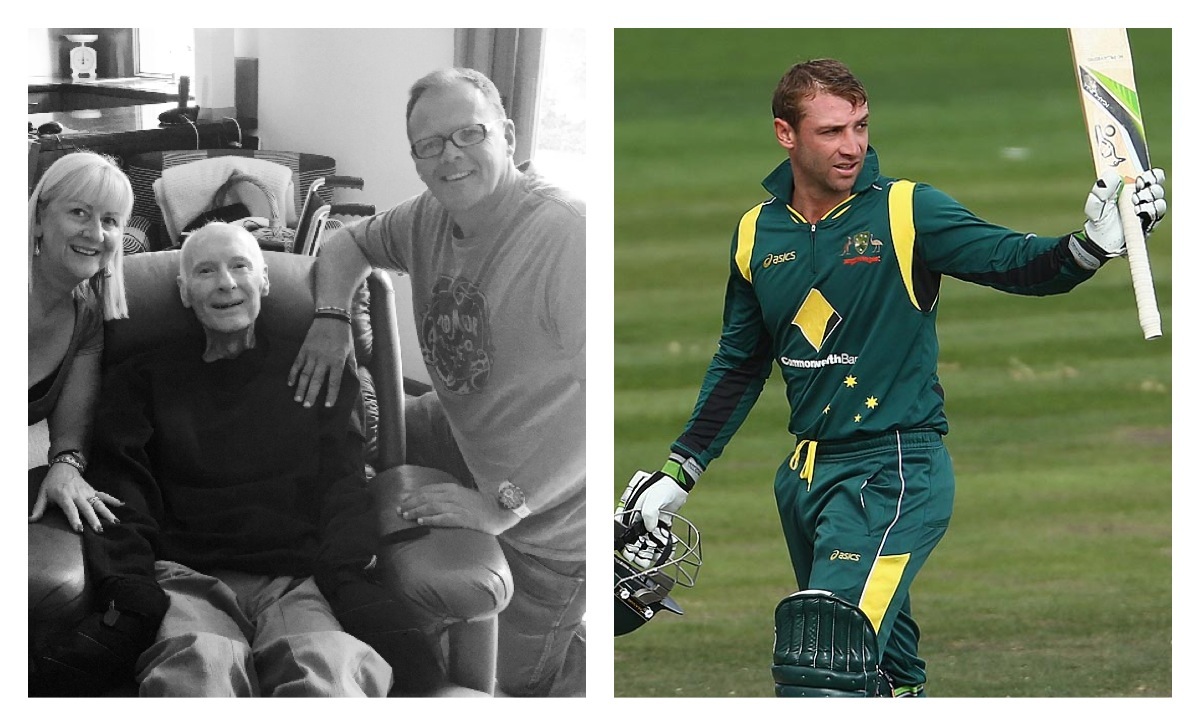
Phillip Hughes and my mate Lloyd

Australia lost one of its national cricket stars last week.

For those of you who don’t know much about cricket, it is enough to say that it is one of Australia’s most loved national sports. During a recent game, Phillip Hughes was hit with a cricket ball and never recovered.  He was just days off his 26th birthday.

In the same week, I had a friend die from the effects of Motor Neurone Disease (MND) or ALS to those in the States. As I also have this disease, I met Lloyd and his wife Adele at our local MND support group.  I had the privilege of sharing my faith with him and praying with him to begin a relationship with God just weeks before His death.

I have written blogs about death before, but today I want to focus on those left behind. The ones who sit in funerals, sort through clothing, write eulogies.  I want to encourage you that in life’s most desperate moments that you can acquire a newfound value in life.

Our Prime Minister said this week, “Phillip Hughes’ passing is a reminder that life is both precious and fragile.”

I wonder, if that is true, do we live like it is? When we hear the words “precious and fragile”, many of us reflect on the fact that life in general is precious or fragile or that someone else’s life is fragile and precious.

It’s easy to hear these words without personalising them.

Let me do that for you: You are precious and you are fragile, you are one of a kind, valuable, not worthless.

By fragile, I’m not talking about the resilience of the human spirit, in fact, I am constantly blown away by people’s resilience. I am talking about our earthly body, amazing in complexity and also not infallible.

By precious, I’m not talking about lovely or superficial, I’m talking about rare, one of a kind, and uniquely destined for great things.

I have been to many auctions in my life and I like watching auction shows on TV. It is true that the most fragile and precious articles more often hold the most value.  Even if I wouldn’t buy it, someone else is willing to pay large sums– it’s all in the perspective of the buyer.

If our value is found in what others would give for us then consider this: Jesus gave His life for us. The Bible says, even when we were seemingly worthless, He put worth on us by paying the highest price a friend could pay: His own life. [Romans 5:8]

Have you noticed how people treat things that are precious and fragile? It is with respect, with a sense of awe, wonder and love.

The Bible also teaches us that we are wonderfully made and precious to God, and that we are His treasured possession.

If we would understand our intrinsic value today, it would change the way we treat ourselves and the way we treat others. We would love our neighbour like we were made to.

My challenge to you today is to see yourself as one-of-a-kind, and handle yourself with care. Then, see the people you are doing life with as equally valued, they are precious and fragile too.

Phil

Blog at WordPress.com.

Up ↑