Search

Fridays with Phil

Life, family and unshakeable faith

Author

Admin

Money Master

Proud of my youngest, their first home!

No matter where I go in the world, I see that money plays a pivotal role in people’s lives. One thing I know to be true is you master money or it masters you.

Just like a master says to the servant “go” and they go, or “come” and they come, if you master your money, you know where it comes from and can send it where you want it to go.

Why am I encouraging you to master your finances in this way? Because if you don’t, someone else or some other thing will.

More than that, you need to decide for yourself what is important to you long term. Do you want to leave a legacy of being generous to those in need, investing into people who will live beyond you and making sure you resource the important things in life?

While I don’t pretend to be an expert, I’m a pastor afterall, here are a few things I have done for years that have helped me control my money –

  • Know your current reality. Do you know exactly how much you earn and spend each week? Do you know where all your income is coming from and where all your spending is going? It starts with writing it down.
  • Create a budget. With a budget, I can decide how much I spend, and what I spend it on. I can see if I need to immediately reduce my expenditure so that it is less than my income. I would be happy to send you a template budget I use (just reply to this blog below so I have your email).
  • Try basing your standard of living on less than your total income. For example, if you are a two income family, you could try living off one salary. This hasn’t always worked for us, but in trying, we have usually only ever lived off 1.5 salaries. The discipline of this, even choosing not to immediately apply pay increases to your spending, sees you able to save and give more.
  • Schedule set amounts to automatically come out of your account so that when the rates, electricity or gas bills come in you are already in front and prepared. I also do this in tithing and giving to my Church: a biblical principal and non-negotiable in my life, allocating resources to what is important to me.
  • Value things with reference to your savings, not your earnings. For example, if a TV costs $3,000 and I earn $600 per week then it doesn’t seem too expensive because it’s only 5 times my weekly salary. However, if I value the TV by how much I save, say $60 per week, then that TV costs 50 times my weekly savings. I should probably think hard about spending 1 year’s savings in one go.
  • Consider tomorrow. I have often wondered if God provides on His foreseeing knowledge. I would encourage you not to spend everything you get today as it could be for what you don’t see coming up in the future. Those who are ready for opportunity can respond to it.
  • Ask for help. If you don’t know where to start with making a budget, or saving for a house, find someone who can show you how. Over the years, many young couples have asked me for help and I hope I have set them up for a life of mastering money.

If the Bible is true when it says that you can have only one master, don’t let money be yours!

Phil
Every six minutes

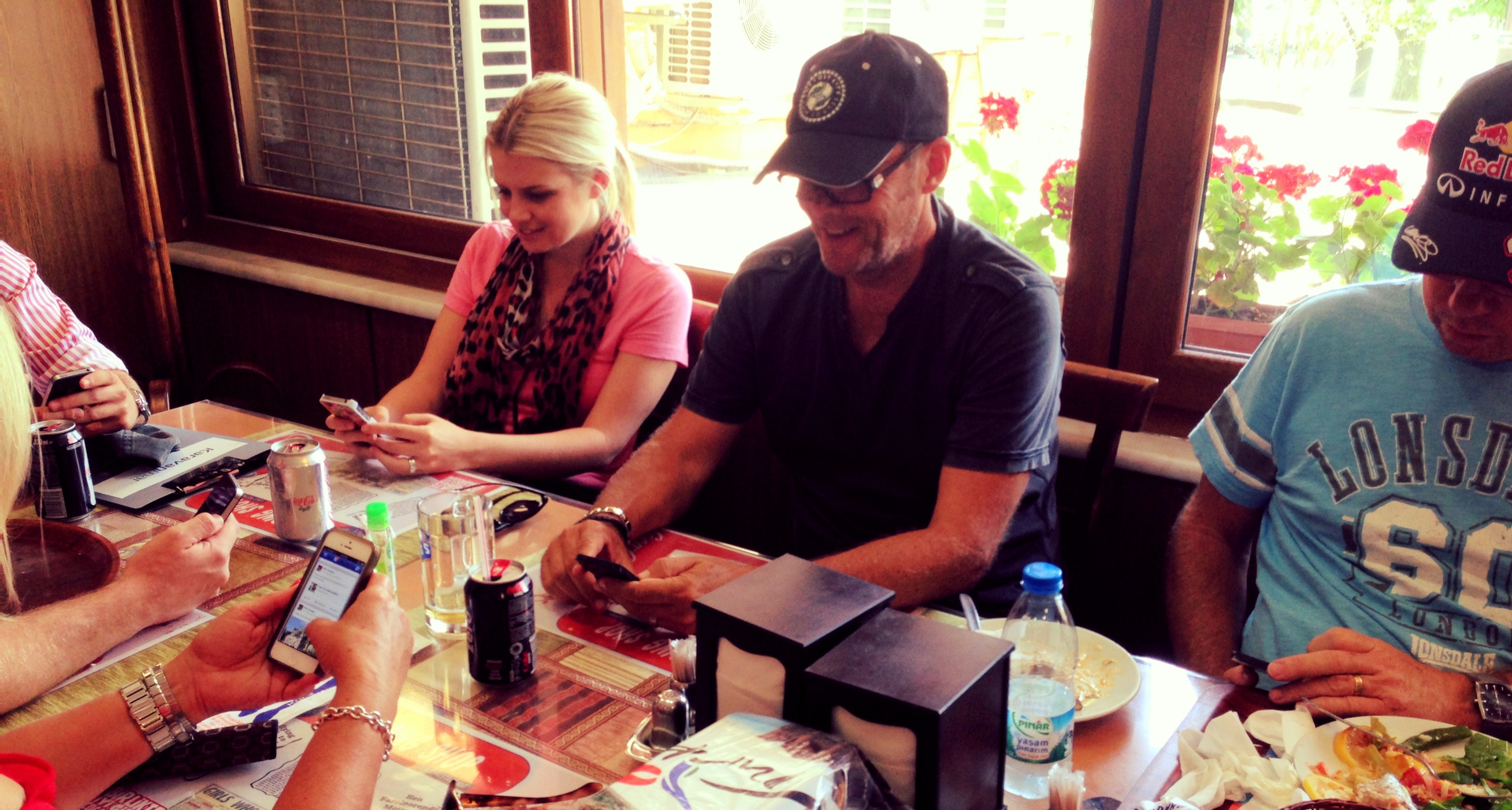
A little distracted  (Photo taken on a family trip in Istanbul, Turkey last year)
A little distracted
(Photo taken on a family trip in Istanbul, Turkey last year)

If you are what’s considered an average smartphone user then you check your phone 150 times per day. That’s every six and a half minutes.

We are wired, habitually and socially, to connect with others from all over the world at any moment in time through media forums like facebook, blogs and email. In fact, right now I am speaking to you through one of those.

I just wonder if this type of conversation, now normal, inhibits us connecting with others beyond surface level and with God in a deep way. Perhaps, we have discovered how to be partly tuned into everyone while becoming less connected or tuned into anyone.

We have all become experts in the act of multi-tasking, that is, doing lots of things at once, but how good are we at “uni-tasking”, doing one thing at once?

How do you go focussing on one thing or one person and keeping out all the other noise?

A good way to gauge this is to think of whether you allow your phone at the table when you sit down to a meal or if you allow alerts to interrupt quality time with family and friends. Maybe it’s time you put measures in place to try some uni-tasking.

While there’s no doubt that conversations with one another are important to connect us relationally, the way we converse with God is perhaps the most important conversation of them all. I know it is in my life.

My conversations with God are allowed to be raw and real as I expose my heart and feelings with Him. To talk with Him is to acknowledge His presence and power whilst revealing my need for Him and ultimately my trust in Him. It’s simply prayer.

If you’re not sure how to pray today, Jesus shows us one way to have a conversation with our Creator recorded in Matthew 6: 9-13 as “The Lord’s Prayer”. This prayer gives us a blueprint for one type of conversation we can have with God but it is not the only kind. The important thing is that you are communicating with God.

Prayer inspires my very real, present day, dependence on God’s grace. I depend on God for strength to rise above daily challenges, confrontations and tragedies.

I have found that I never leave these conversations without hope. If I invite Him to, somehow, God communicates to my spirit and soul things that encourage and strengthen me. It’s personal. It’s tangible.

If you’re a busy parent then don’t fret, you can talk to God while feeding or washing kids. A business person can talk to God in the middle of a board meeting or travelling to and from work. I have even spoken to God when signing important documents or while doctors are inflicting painful tests on my body.

Conversations with God can take place at anytime and anywhere.

I encourage you, in light of the number of conversations and frequency of conversations we are all engaged in, let’s not neglect the most important conversation of all.

Phil

Worst Case

My niece practicing for the worst case on a recent cruise.

Last week I was glad to hear that my blog encouraged some conversations about real life and suffering.

Disability, sickness, bankruptcy, mental illness, burnout and divorce are all situations which can sometimes seek to isolate and disorient people. Many of us are afraid to talk openly about these things at all, even in a “preventative” sense.

However, I think that if we can settle the “worst case” scenarios of life, then we can move on to living life confidently and to the full.

Consider the fact that every lifesaving organisation in the world practices for worst case scenarios.  The helicopter rescue service, surf lifesaving, fire brigade, paramedics, air force, and the army all do it. I don’t think they ever hope that they will have to use the skills they practice, but they are ready if or when needed.

In the same way, wise people, businesses and organisations can prepare for uncomfortable scenarios, whether to prevent them or get through them, in the midst of difficulties they face.

It is possible to tackle real issues head on, without compromising hope and belief that the situations we prepare for will not eventuate.  Preparing for the worst case is separate and distinct from wishing it to occur or causing it to happen.

As a dad, when my kids were approaching their teenage years, I could have pretended that they would never get asked to compromise their values, but instead I talked about the possibility with them and asked them what they would say in scenarios if they happened.

We practiced for the worst case. They were ready to say “no” before the tough questions arrived. Preparation gave them (and me!) confidence and courage.

With my kids, as in life, if I prepare for the worst case and it never happens, I have lost nothing. If I don’t prepare and it does happen, I could lose everything.

Whilst we can’t prepare for everything, when it is in our power to prepare those around us for the worst case, then why wouldn’t we?

Think about your own home. I am sure you don’t hope it burns down, yet you install smoke alarms. I am sure you don’t hope it floods, yet you insure against flood damage. Real life requires real precautions and real preparations.

In my life, I face the challenge of what is classified as a terminal illness. If I don’t talk about disability, death and separation from my loved ones as one example of a worst case, I not only fail to prepare myself but I fail to prepare them. Have honest conversations that prepare the ones you love for life.

Check out the attitude of Shadrach, Meshach and Abed-nego in the Bible. These guys were facing serious persecution for their faith and are about to get thrown into a blazing fire by King Nebuchadnezzar.

In Daniel 3:17-18, they boldly declare, “If it be so, our God whom we serve is able to deliver us from the furnace of blazing fire; and He will deliver us out of your hand, O king. But even if He does not, let it be known to you, O king, that we are not going to serve your gods...”

They were confident that regardless of the outcome – best case or worst case, nothing would cause them to deny or stop trusting in God. They had settled the issue of “worst case” in their heart and were able to live freely in that.

I hope you can do the same.

Phil

Telling the truth

Why do you think what you think and believe what you believe? Are your thought patterns based on what you have heard your parents say? Are your beliefs based on a book you read decades ago?

Today, I want to challenge us to switch off the autopilot and not react to difficult questions based on yesterday’s understanding and beliefs.

Many of our reactive answers to complex challenges and ethical dilemmas come from the pressure to give an immediate answer. This is dangerous because it means we can neglect dedicating time to necessary research. Or even worse, we default to what past generations believed, based on what they knew to be true.

For example, there’s our stance on whether a sick person should be able to access medication not yet approved by our nation’s medical board or a terminally ill person’s decision to cease medical treatment altogether. How quickly we draw a conclusion “for” or “against”, but based on what?

I realise that some ideas and beliefs I hold to today I didn’t hold to yesterday. That’s ok. I’m willing to adjust my thinking if realising my error puts me back on the right path. And if necessary, I’m willing to say nothing at all.

There were days when make-up, jeans and voting were not acceptable for females. That seems absurd today. It makes me think, what are those things today that seem “uncomfortable” or even “wrong” but in a few decades from now, after a more considered approach, will seem “right”?

We say so easily, “how times have changed.” Really? Do “times” have the power to change wrong to right or is it ideas and our bias or preconceived ideas that have changed? Maybe over time, wisdom has had a chance to show its hand and directly influence our core beliefs.

Changing ideas does not suggest weakness or defeat. To the contrary, changing ideas suggests bravely confronting real issues that affect real people’s lives. As a Christian, if I fail to consider Christ’s perspective above all else on any given issue, then I miss out on knowing truth. After all, there is no man in history who has better exemplified grace and truth.

I believe in absolutes, but I also understand that we live in a world where I don’t have all the answers. There are certain situations that demand more thought and an open mind and heart.  I can’t afford not to respond to pain with grace.

While I believe in the absolute of divine healing, that God can, does and is able to heal, in the past that has stopped me being open to someone talking to me about their fear of death or their desire to talk to their loved ones about the possibility of not being healed. As if somehow God would refuse to heal those He loves because they discussed real life and suffering.

What I have realised in the midst of my own battle with disease, and mixing with others in similar battles, is that it’s important I don’t answer people’s questions of deep issues with cliché, off the cuff, unthoughtful answers.

What’s important is that I walk a mile in their shoes.

What’s important is that I allow love to direct my response.

Phil

Asking the tough questions

This week Lenore and I are thankful for Hillsong Conference.  We have positioned ourselves in the environment of this Conference spanning over 20 years. Each year, we have received something personal from God and many times it has been the catalyst for a major life change.

Yesterday, we had the privilege of being part of a panel discussing “navigating crisis”.

I was chosen because at this moment my body is suffering with Motor Neurone Disease, a disease that strips the body of all its muscle and leaves the sufferer gasping for breath until their last.  In the past year, I have also met and grieved the loss of friends with this disease.

I love that at such a significant Conference with 25,000 plus people in attendance, we talked so openly about real life crisis.

The bible is not scared to talk about crisis either.  In the book of Acts, we read about the death of James, the brother of John and one of Christ’s followers. It says in Acts 12:2, “Then he (Herod) killed James the brother of John with the sword.”

Imagine the painful separation his brother John faced, losing James at such a young age with so much to live for. They were clearly close: both were fisherman, working for their father, companions of Jesus, leaders of the church. Yet one lives and one dies.

Death can be one such crisis situation. You may be facing the death of a loved one at the moment or maybe life is just hard right now.  You could be wondering, why me? You may even feel judged or blamed for the difficulty you are facing.  I am aware that even in a faith-filled environment, you may feel alone because of the crisis you are in.

Take heart from this story.  Realise that crisis can touch us all, even the friends of Jesus.  Even though you may not feel like it in a hard situation, you are God’s beloved child, His “favourite”, in and out of crisis.

The love of Jesus Christ is as much a reality for those who are living life to the full and those who are experiencing the challenges of life and crisis.

I am also encouraged by John’s reaction to the loss and crisis he faced in losing his brother James.  It did not destroy his faith or stop his walk, it did not take his courage or hinder his calling.

Like John, let’s choose to press forward.  Let’s not allow crisis to cause us to step sidewards or backwards from God’s calling for our life.

In whatever season you find yourself in today, trust me when I say this, environments of love and faith like Hillsong Conference and like your local Church will only bless your life.  So please don’t stay away.  Even if it feels like the hard thing to do, it doesn’t mean it is not the right thing to do.

Phil

The God I never knew

I wonder how many times God has intervened in my life without me realising it.

I am sure I live unaware of God’s provision, protection and help in my life.

Just as God asks us to do acts of kindness without the big fanfare of public recognition, God is always doing things on our behalf that He doesn’t let us in on. His kindness is at work constantly.

I think of the bible passage in Acts 9:1-5 which speaks about Paul on his way to arrest and execute Christians. The Bible says in verse 3, “As he journeyed he came near Damascus, and suddenly a light shone around him from heaven.”

While Paul was on his way to harm these people, he is instead arrested by Christ’s love and his life is changed.

My thoughts are towards the ones who didn’t know the danger they were in as Paul was on his way, and “near to them” to destroy them.   Because God intervened, they were saved from harm.

I also think of the Israelite people who suffered persecution from the Egyptians, described in the book of Exodus.

Even while they were suffering and praying for deliverance, God was working and preparing Moses as a child to be the answer to their prayers and they didn’t even know God was already at work.

I think of my life, still walking around with MND more than a year after doctors said I shouldn’t be able to. I think of the time in Zanzibar that my limbs cramped and my friend swam out to rescue me from drowning. I think of the time in Auckland when I came off my scooter, breaking my scapula and narrowly missing being run over by a truck– and I’m sure you have similar stories.

Maybe that’s why pride is so dangerous: it ignores the fact that God is working behind the scenes. It fails to give him credit for the less visible signs of His grace and goodness. It takes the wins on its own merit.

Even though I am proud of what I can see tangibly around me, I am convinced that I am also unaware of the extent of God’s grace that has helped me and caused me to succeed.

I may never know the number of times God has intervened and rescued me.

So once you are finished thanking God for those things in your life that you can see, remember to thank him for the things that you can’t. Be thankful for the unseen hand of God’s presence always making a way.

Never give up on trusting God to come through for you even when it seems too late. Trust His timing in all things. While there is hope, there is life. God is always working on your behalf for your good.

Phil

The time I found Madonna

Bruges, Belgium

After a wonderful time away, it is good to be back in Australia and back blogging with you.

Home at last, I was recounting one of the more unexpected adventures of the trip.

It was in Bruges, Belgium where I overheard that Michelangelo’s Madonna and Child is housed in a local Church, recently depicted in the movie Monuments of Men.

Ever since I saw first Michelangelo’s David in Florence and his Moses in Rome, I have marvelled at his God-given gift to bring stone to life.

Knowing my walking restrictions, I calculated exactly how far it would take to get there by foot and started out.

When I finally arrived at the Church, it was locked and empty. I managed to sneak through a side-alley door and saw a sculpture of Mary holding an infant Jesus, but after taking a few pictures, I realised that this was not it.

I had ended up even further away from the real Madonna and Child than where I had started. It’s tough when you have worked so hard and moved so far only to find that you’ve arrived at the wrong destination.

In that situation, in life generally, there’s only one thing to do: keep going.

Rather than camping at your mistake, misdirection or wrong destination, I would encourage you to get up, gather your strength and make a change.

Learn from your mistake but don’t let it dampen your resolve to get to your passion.

Your passion could be raising great kids, becoming a generous giver, health, a strong marriage, business success, running a marathon, or an intimate relationship with God.

You will only ever get there if you are heading in the right direction.

There is a difference between moving and moving in the right direction. The difference is velocity.

Speed is all about how fast we move whereas velocity is all about the rate at which we change our position. Velocity is speed with direction.

Many people can be in a frenzy and have great speed but end up back where they started. Others know the direction they want to take but fail to act and procrastinate along the way.

If you’re a leader, building team takes you to a great destination and changes your future potential. If you’re a spender, budgeting and saving money causes you to become generous. If you’re a parent, nurturing, loving and passing on morals causes you to raise kids you will be proud of.

Three questions for you:

  1. Is there a lot of activity going on in your world?
  2. If so, is that activity moving you, changing your position?
  3. If so, are you moving in the right direction?

The key is making sure you’re heading in the right direction. Speed is important, but so is direction.

After adjusting my direction, and even though I was now moving at a much slower pace, I did eventually find the Madonna and Child that day and it was truly beautiful. The journey was certainly well worth it.

Imagine where you could be, or what you could see, if you became aware of the direction you were heading in?

Phil

Hello from Paris

Bonjour! Today I write to you from the streets of Paris. St Germain is buzzing and the sound of live music fills the air.

One thing I love about Paris is the “joie de vivre”, the “joy of living”, all around.

Parisians know how to enjoy the simple things: the joy of savouring a meal, sipping a glass of red, strolling through the Jardin du Luxembourg by kids playing with boats in fountains, and couples on chairs enjoying each other and the warm sun.

It’s a special place. But so is your life. So slow down and enjoy the simple things.

Let’s face it, I could eat cheese and bread in Australia, the difference is that here, I slow it down and enjoy the moment.

To experience Joie de Vivre in your everyday life, declutter and do what only you can.

When I was first diagnosed with Motor Neurone Disease, I had to decide what areas of my life needed to be left and what areas I needed to continue. Really it wasn’t that hard.

No one else can be a dad to my children or a husband to my wife like I can. No one else could take responsibility for my personal fight with this disease. However others could do pretty much the rest.

It may not need to be that drastic for you, but what are the things from your current task list that only you can do?

I’m not talking about the small details, I’m talking about the big rocks, the things that consume most of your time. Maybe you haven’t yet discovered what only you can do, trust me, it will be a worthwhile exercise.

Whatever it is, do it with all your heart.

If you’re a mum or dad, a friend or spouse, do your very best. There are no second chances at that. Do it well the first time.  To help you with that, this is something I picked up a long time ago and it has framed how I try to live my life as an adult:
1. Find out what you do well.
2. Do a lot of it.
3. Find out what you don’t do well.
4. Don’t do much of it.
5. Find out what others do well.
6. Help them do it.

Today marks my 21st blog. A big thank you to the 15,000+ readers across 60 countries who have taken the time to either read, share, or comment on these blogs.

Healthwise, I am doing better than the doctors expected. After thinking last year would be our final trip to Europe, we have decided to make the most of my mobility and take another trip. This time, we are joined by my late brother’s wife who has never been overseas.

I look forward to catching up with you on my return in four weeks and continuing this blogging journey.

By the way, in November I will be adding “grandpa” to my list of “what I can only do” as we await the arrival of our first grandchild to Jess and Kaiden.

Phil

Look for the stars while you take out the trash!

I am a Formula One fan.

Not only have I watched it for years but I’ve also been to the Singapore and Monaco Grand Prix.

There have been few rivalries in motor racing like that of Niki Lauda and James Hunt’s. Theirs is a legendary tale, now depicted in the movie “Rush.” It tells the true story of a fierce competition for the title of World Champion in the 70s.

Near the end of the movie, after Lauda’s infamous motor racing accident, which left him severely burned and fighting for his life, these rivals meet again. Lauda recounts his Doctor’s wise words,

“Mr. Lauda, may I offer a piece of advice? Stop thinking of it as a curse to have been given an enemy in life, it can be blessing too. A wise man gets more from his enemies than a fool from his friends.”

Niki Lauda with his wife and son shortly after the near fatal crash in 1976.

I love that line: “A wise man gets more from his enemies than a fool from his friends.”

I put it this way: “Look for the stars while you take out the trash.”

Lauda’s enemies were twofold: Hunt & his injuries.  My enemy is Motor Neurone Disease (MND).

It is a disease with no cure and kills 2 people in Australia each day, while another two are diagnosed. Its sufferers lose all use of their muscles, eventually being unable to walk, move their arms or hands, eat, talk, or breath.

I have this disease (it doesn’t have me) and I have friends who are further down the road than me. When I visit them, I’m looking into the mirror of who I may become, except for a miracle or a cure.

How much do you think that makes me value walking, eating, and breathing now? In this way, my enemy has somehow helped me appreciate what I once took for granted.

Before I was diagnosed with the disease, I hated the interruption of taking the bin out to the end of the driveway for pick-up the next morning. Now I am grateful that I can still do this chore. Not only can I take out the trash, but I can look up and take one more opportunity to see the stars.

I am in awe of the stars, to gaze at God’s handiwork even as I stand amongst the stench of rubbish, this disease, the frustration of my body degenerating: my enemy.

Some have fiercer enemies, deeper valleys, or more rubbish in their life than others, but maybe its also a longer, deeper, and wider opportunity to gaze at the stars and to consider the beauty in the storm.

Our enemy, whatever it looks like, instead of bringing evil, may just with God’s help bring some good.  What I am endeavouring to do in the midst of my challenge of MND is allow it to do what sometimes only an enemy can do: bring to the surface treasure once hidden.

I think if you allow wisdom to have its way you too can gain something from your enemy.

So walk slowly back next time you take the rubbish out and take a look up. And remember, “A wise man gets more from his enemies than a fool from his friends.”

Phil

MND Awareness Week (May 4-10)

Visit http://www.mndaust.asn.au
Awareness is the first step towards a cure. You may want to also sign the “Five Rights Petition” or even give a donation to the MND Research Institute of Australia.

Visit http://www.mndandme.com.au
This week Scott Sullivan, the founder of this organisation sadly passed away. I’m sure the foundation would value any support.

Blog at WordPress.com.

Up ↑