I have been asked so many times what I’m doing, so this post is a personal breakdown of what I currently do to maintain the best possible quality of life. If you’re living with MND—or love someone who is—I hope this offers a helpful and honest insight into what’s working for me.
This is not a guarantee of any kind that if you do what I do you will get the same results but you may find something helpful and worth trying.
When I was diagnosed with motor neurone disease, I knew I couldn’t control the condition—but I could influence how I lived with it. Like everyone diagnosed with ALS/MND, I was told it is 100% fatal and progresses rapidly, with no known cure.
Did you know that in Australia, around 1 in 200 people will die from motor neurone disease (MND)? That’s around 3 a day.
It’s often called a rare disease, but that’s misleading. The reason it seems rare is because people with MND die quickly, so the number of people living with it at any one time is low.
For example, the average life expectancy after an MND diagnosis is just 27 months, compared to 20 or more years for someone with multiple sclerosis (MS). Each year similar numbers are diagnosed with MND and MS. However, because MND progresses so rapidly, far fewer people are alive with it at any time—around 2,700 compared to 33,000 living with MS.
So, while MND may look rare based on how many people are currently living with it, the truth is: it’s not rare at all. It’s just fast.
Slowing it down.
Over the years, I’ve committed to slowing its progression in every way I can: medically, nutritionally, physically, emotionally, and spiritually. What I share here isn’t a prescription—it’s my personal rhythm of life, built on professional advice, careful observation of my body, and a fair bit of prayerful discernment.
That doesn’t mean chasing false hope or miracle cures. It means choosing to live with MND in a way that’s purposeful, hopeful, and as proactive as I can manage.
I like to say, “I may have MND but MND doesn’t have me”.
1. Medical and Allied Health Team
I’m fortunate to be supported by a knowledgeable and compassionate medical team. I stay in regular contact with my neurologist, GP, and allied health professionals:
• Physiotherapist (monthly): We focus on maintaining range of motion, balance, and strength. My physio trains my carer, and together we implement a movement routine.
• Occupational Therapist: Assists with adaptive tools and seating to reduce energy expenditure and prevent injury.
• Speech Therapist (every 6 months): Monitors for slurred or slow speech, changes to the tongue, lips, or jaw, and signs of respiratory involvement.
• Respiratory Therapist: Measures lung function, coughing ability, and oxygen levels.
• Psychologist: Helps navigate the emotional complexities and shifting landscape of living with MND.
2. Supplements and Nutritional Support
For over 10 years, I’ve worked with a naturopath to support my health. We began by testing for heavy metals and toxins. Result was many high levels but mercury in particular was 17x higher then normal. I spent 6 hours in a dentist chair removing my amalgam fillings (which contain mercury, tin, silver, copper, and zinc).
My daily supplement regimen targets muscle maintenance, energy, neuroprotection, gut health, and detoxification.
I have been taking these supplements for the past 10 years or more, mixed in juice as soon as I wake up, about an hour before breakfast. Interestingly, a paper has just been produced by a known ALS researcher that has endorsed what I’ve been doing all these years.
Amino Acids & Neuroprotective Compounds
• Acetyl-L-Carnitine (1000 mg) – Mitochondrial energy, cognition, nerve protection
• Alpha-Ketoglutaric Acid (600 mg) – Energy metabolism, ammonia clearance
• N-Acetylcysteine (NAC) (500 mg + 800 mg) – Glutathione precursor, antioxidant
• L-Glycine (500 mg) – Neurotransmitter balance, sleep support
• L-Isoleucine (500 mg) – Muscle maintenance
• L-Leucine (1000 mg) – Muscle protein synthesis
• L-Lysine (600 mg) – Tissue repair, immune function
• L-Ornithine (300 mg) – Fatigue and ammonia detox
• L-Serine (500 mg) – Brain cell membrane support
• L-Tyrosine (1500 mg) – Dopamine precursor, cognitive support
• L-Valine (600 mg) – Muscle repair and energy
Mitochondrial & Energy Support (Mito-Charge)
• D-Ribose (4.6 g) – Boosts cellular ATP production
• Nicotinamide Riboside (100 mg) – Raises NAD+ for mitochondrial function
• Calcium Pyruvate (666 mg) – Energy support
• Magnesium Citrate (100 mg elemental) – Nerve and muscle function
• Calcium Pantothenate (60 mg B5) – Adrenal support
• Taurine (50 mg) – Antioxidant and neuroprotective
• Biotin (1 mg) – Nerve health and metabolism
• Acetyl-L-Carnitine – Included again for double mitochondrial support
Liver Support (HepatoClear)
• Silymarin (Milk Thistle) – Liver cell protection
• Schisandra – Adaptogen, hormonal and liver detox support
• Turmeric/Curcumin – Anti-inflammatory and antioxidant
• Artichoke/Dandelion – Bile flow and digestive support
Other Daily Supplements taken morning, midday and afternoon.
• Omega-3 Fish Oil – 2,000 mg (EPA/. DHA)
• Ox Bile
• L-Methylfolate
• Coconut Oil
• Superoxide Dismutase (SOD)
• Ginkgo Biloba
• Adeno B12
• Methyl-Guard Plus
• BIFIDO Biotic
• UltraBiotic 45
• Vitamin D3 – 1,000 IU
• QH absorb + PQQ
• Tri-Mag Supreme
• Probiotic (broad-spectrum) – 1 capsule daily
• Curcumin with Bioperine – 1,000 mg
• Methylated B-Complex – 1 capsule daily
• Lypo-Spheric Vitamin C
• Liposomal Glutathione
• Liver Nutrients
• Pro8-50Plus
• SB 250 Spectrum
• Standalone Magnesium – Sleep and muscle relaxation
• Augmented NAC – High-dose antioxidant support.
• Optimal PC, ‘phospholipid complex’. 800mg
• Lithium 1000mcg
• Cal-Mag Plus (Zinc, Vit D&K,Boron.
• Muti Enzyme
• Hydroxide B12 2000mg
• Vitamin E
• Methyl Folate Extra strength 400mcg
• Zinc Picolinate 25mg
• Protein Powder. Whey Healthy Chef.
Yes, MND can be incredibly costly—emotionally, physically, and financially.

3. Movement and Physical Therapy
Movement is vital—not about pushing through pain, but preserving function.
My Daily Routine:
• Range-of-motion stretches (15 minutes): Neck, shoulders, back, legs
• Targeted stretching (45 minutes)
• Walking short distances with aids or using a powered wheelchair to stay connected with life beyond the home.
• Breathing exercises (3–4 times daily): Deep, slow breath holds to support lung function
• Resistance exercises to maintain—not build—muscle. It’s important to note that I haven’t reversed any effects of MND, but I’ve worked hard to preserve what function I still have.
• MotoMed machine – 2 hours daily. A MotoMed is a motorised exercise machine that helps me move my arms and legs to improve circulation, flexibility, muscle tone and memory.
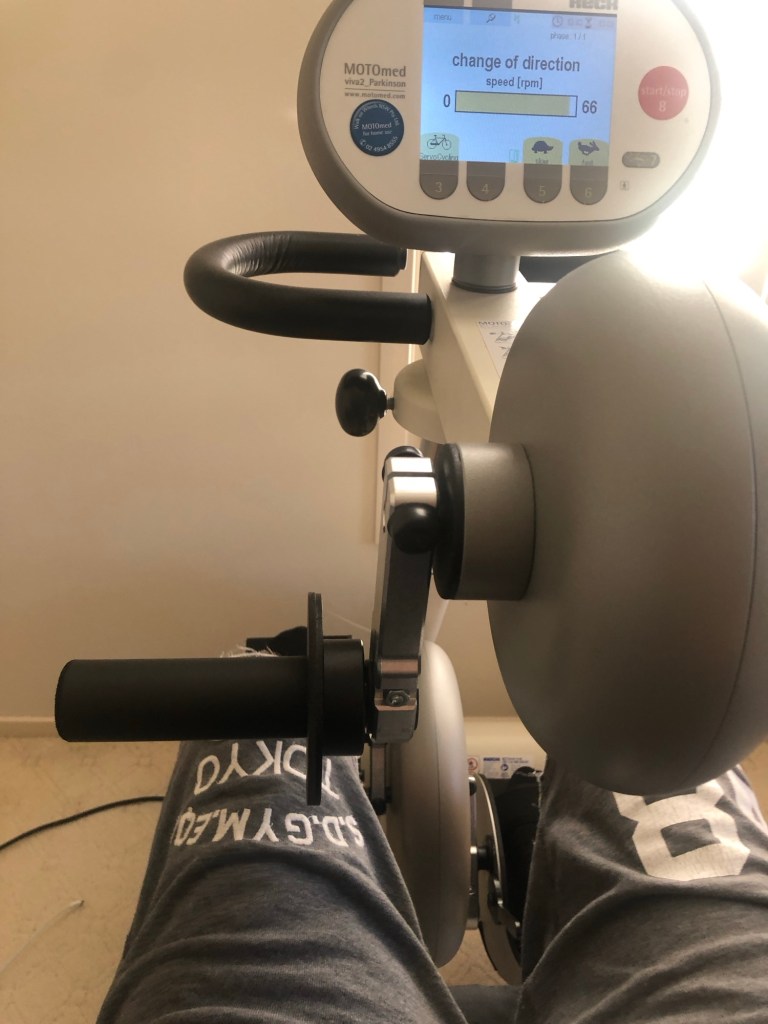
• Sauna – 30 minutes daily: I complete some exercises during this time
Additionally, I receive soft tissue therapy (3 hours per week) to reduce stiffness and spasticity, and improve circulation.
4. Sleep and Symptom Support
Rest is critical. My structured routine includes:
• Bed by 9:30 pm; up by 6:00 am
• No iPad/iPhone after 5:30 pm, dim lights.
• when I rest my head I give thanks and gratitude for another day and usually fall asleep within 10–15 minutes.
• I’ve also found full-leg pressure boots helpful. I wear them for 60 minutes each evening while watching TV. Thanks Gordo (friend with MND), great recommendation.

By around 4:30 p.m., I usually finish my day’s work. My muscles have been exerting themselves to the fullest, with some muscles now working overtime to compensate for the loss of muscle elsewhere. My head feels heavy, and my neck muscles are struggling by late afternoon.
5. Equipment and Tech Support
To conserve energy and maintain independence, I use:
• Powered wheelchair.
• Adjustable bed and seating
• Smart home tools (lights, blinds, communication)
• Respiratory aids on standby.(NIV)
6. Spiritual Life and Inner Strength
MND affects more than the body. I protect my mental and spiritual health by:
• Staying connected to friends, church, and community
• Accepting help—even when it challenges my pride
• Journaling and writing devotionals each morning.
• Seeking counselling, peer support, and honest conversations with others on a similar path.
• FaceBook page: Australian MND Group Connect Share Support.
My relationship in Jesus is my deepest source of strength. I seek His life, light, and love each day. I draw strength from daily Bible reading, prayer and meditation.
MND hasn’t diminished my faith—it has deepened it. As my body slows my spirit grows.
7. Living with Purpose and Advocacy
I want to live well—not just longer—and help others do the same. When life throws challenges our way, we often ask, “What’s the purpose of this?” Sometimes, there is no purpose—until we choose to bring purpose to it.
Viktor Frankl’s in Man’s Search for Meaning: “we can find or create meaning even in suffering”. That’s why I’ve taken on these advocacy roles:
• Chair, Lived Experience Research Advisory Panel
• Advisor, MND Australia Lived Experience Network
• Board Member, Australian MND Research Collective
• Panel Member, Australian MND Guidelines
• Co-designer, Non-Invasive Ventilation Stakeholder Advisory Group
• Advisor, Community of Practice for MND Care (Calvary Hospital)
• Contributor, FightMND and fundraising events
• Board Member, local church
• Member, FIGHTMND Global Research Roundtable
• Administrator, Facebook support page for people with MND (1,500+ members)
Final Thoughts
I can’t say for certain whether these choices have slowed the progression of my MND, but I can say they’ve helped me live more freely within it. Given how rapidly things progressed in the first year, and how much more slowly since I began my current approach, I can only assume I’m on the right track.
It’s allowed me to keep showing up—for my family, my friends, my faith, and even strangers who’ve written to say, “Thanks. I needed that.”
If you’re facing MND, or walking with someone who is, my encouragement is this:
Do what you can, let go of what you can’t, and hold onto the hope that—even in this—life is still worth living.
I finish by thanking my wife, Lenore, and my family for their continued love and support.







 Fridays with Phil
Recent Comments