Search

Fridays with Phil

Life, family and unshakeable faith

Tag

hope

Living Intentionally with ALS/MND: My Personal Journey to Slowing Progression.

I have been asked so many times what I’m doing, so this post is a personal breakdown of what I currently do to maintain the best possible quality of life. If you’re living with MND—or love someone who is—I hope this offers a helpful and honest insight into what’s working for me.

This is not a guarantee of any kind that if you do what I do you will get the same results but you may find something helpful and worth trying.

When I was diagnosed with motor neurone disease, I knew I couldn’t control the condition—but I could influence how I lived with it. Like everyone diagnosed with ALS/MND, I was told it is 100% fatal and progresses rapidly, with no known cure.  

Did you know that in Australia, around 1 in 200 people will die from motor neurone disease (MND)? That’s around 3 a day.

It’s often called a rare disease, but that’s misleading. The reason it seems rare is because people with MND die quickly, so the number of people living with it at any one time is low.

For example, the average life expectancy after an MND diagnosis is just 27 months, compared to 20 or more years for someone with multiple sclerosis (MS). Each year similar numbers are diagnosed with MND and MS. However, because MND progresses so rapidly, far fewer people are alive with it at any time—around 2,700 compared to 33,000 living with MS.

So, while MND may look rare based on how many people are currently living with it, the truth is: it’s not rare at all. It’s just fast.

Slowing it down.

Over the years, I’ve committed to slowing its progression in every way I can: medically, nutritionally, physically, emotionally, and spiritually. What I share here isn’t a prescription—it’s my personal rhythm of life, built on professional advice, careful observation of my body, and a fair bit of prayerful discernment.

That doesn’t mean chasing false hope or miracle cures. It means choosing to live with MND in a way that’s purposeful, hopeful, and as proactive as I can manage.

I like to say, “I may have MND but MND doesn’t have me”.

1. Medical and Allied Health Team

I’m fortunate to be supported by a knowledgeable and compassionate medical team. I stay in regular contact with my neurologist, GP, and allied health professionals:

• Physiotherapist (monthly): We focus on maintaining range of motion, balance, and strength. My physio trains my carer, and together we implement a movement routine. 

• Occupational Therapist: Assists with adaptive tools and seating to reduce energy expenditure and prevent injury.

• Speech Therapist (every 6 months): Monitors for slurred or slow speech, changes to the tongue, lips, or jaw, and signs of respiratory involvement.

• Respiratory Therapist: Measures lung function, coughing ability, and oxygen levels.

• Psychologist: Helps navigate the emotional complexities and shifting landscape of living with MND.

2. Supplements and Nutritional Support

For over 10 years, I’ve worked with a naturopath to support my health. We began by testing for heavy metals and toxins. Result was many high levels but mercury in particular was 17x higher then normal. I spent 6 hours in a dentist chair removing my amalgam fillings (which contain mercury, tin, silver, copper, and zinc).

My daily supplement regimen targets muscle maintenance, energy, neuroprotection, gut health, and detoxification.

I have been taking these supplements for the past 10 years or more, mixed in juice as soon as I wake up, about an hour before breakfast.  Interestingly, a paper has just been produced by a known ALS researcher that has endorsed what I’ve been doing all these years.

Amino Acids & Neuroprotective Compounds

• Acetyl-L-Carnitine (1000 mg) – Mitochondrial energy, cognition, nerve protection

• Alpha-Ketoglutaric Acid (600 mg) – Energy metabolism, ammonia clearance

• N-Acetylcysteine (NAC) (500 mg + 800 mg) – Glutathione precursor, antioxidant

• L-Glycine (500 mg) – Neurotransmitter balance, sleep support

• L-Isoleucine (500 mg) – Muscle maintenance

• L-Leucine (1000 mg) – Muscle protein synthesis

• L-Lysine (600 mg) – Tissue repair, immune function

• L-Ornithine (300 mg) – Fatigue and ammonia detox

• L-Serine (500 mg) – Brain cell membrane support

• L-Tyrosine (1500 mg) – Dopamine precursor, cognitive support

• L-Valine (600 mg) – Muscle repair and energy

Mitochondrial & Energy Support (Mito-Charge)

• D-Ribose (4.6 g) – Boosts cellular ATP production

• Nicotinamide Riboside (100 mg) – Raises NAD+ for mitochondrial function

• Calcium Pyruvate (666 mg) – Energy support

• Magnesium Citrate (100 mg elemental) – Nerve and muscle function

• Calcium Pantothenate (60 mg B5) – Adrenal support

• Taurine (50 mg) – Antioxidant and neuroprotective

• Biotin (1 mg) – Nerve health and metabolism

• Acetyl-L-Carnitine – Included again for double mitochondrial support

Liver Support (HepatoClear)

• Silymarin (Milk Thistle) – Liver cell protection

• Schisandra – Adaptogen, hormonal and liver detox support

• Turmeric/Curcumin – Anti-inflammatory and antioxidant

• Artichoke/Dandelion – Bile flow and digestive support

Other Daily Supplements taken morning, midday and afternoon.

• Omega-3 Fish Oil – 2,000 mg (EPA/.  DHA)

• Ox Bile

• L-Methylfolate

• Coconut Oil

• Superoxide Dismutase (SOD)

• Ginkgo Biloba

• Adeno B12

• Methyl-Guard Plus

• BIFIDO Biotic

• UltraBiotic 45

• Vitamin D3 – 1,000 IU

• QH absorb + PQQ 

• Tri-Mag Supreme

• Probiotic (broad-spectrum) – 1 capsule daily

• Curcumin with Bioperine – 1,000 mg

• Methylated B-Complex – 1 capsule daily

• Lypo-Spheric Vitamin C

• Liposomal Glutathione

• Liver Nutrients

• Pro8-50Plus

• SB 250 Spectrum

• Standalone Magnesium – Sleep and muscle relaxation

• Augmented NAC – High-dose antioxidant support.

• Optimal PC, ‘phospholipid complex’. 800mg

• Lithium 1000mcg

• Cal-Mag Plus (Zinc, Vit D&K,Boron.

• Muti Enzyme

• Hydroxide B12 2000mg

• Vitamin E

• Methyl Folate Extra strength 400mcg

• Zinc Picolinate 25mg

• Protein Powder. Whey Healthy Chef.

Yes, MND can be incredibly costly—emotionally, physically, and financially.

Pic of breakfast.

3. Movement and Physical Therapy

Movement is vital—not about pushing through pain, but preserving function.

My Daily Routine:

• Range-of-motion stretches (15 minutes): Neck, shoulders, back, legs

• Targeted stretching (45 minutes)

• Walking short distances with aids or using a powered wheelchair to stay connected with life beyond the home.

• Breathing exercises (3–4 times daily): Deep, slow breath holds to support lung function

• Resistance exercises to maintain—not build—muscle. It’s important to note that I haven’t reversed any effects of MND, but I’ve worked hard to preserve what function I still have.

• MotoMed machine – 2 hours daily. A MotoMed is a motorised exercise machine that helps me move my arms and legs to improve circulation, flexibility, muscle tone and memory.
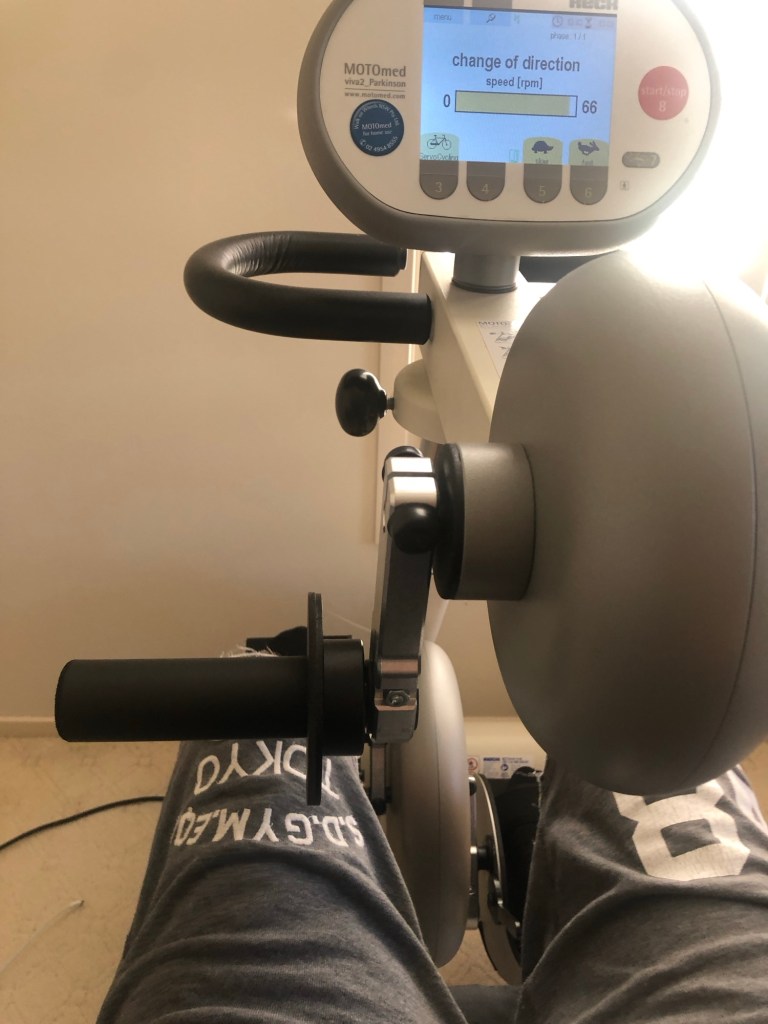
MotoMed

• Sauna – 30 minutes daily: I complete some exercises during this time

Additionally, I receive soft tissue therapy (3 hours per week) to reduce stiffness and spasticity, and improve circulation.

4. Sleep and Symptom Support

Rest is critical. My structured routine includes:

• Bed by 9:30 pm; up by 6:00 am

• No iPad/iPhone after 5:30 pm, dim lights. 

• when I rest my head I give thanks and gratitude for another day and  usually fall asleep within 10–15 minutes.

• I’ve also found full-leg pressure boots helpful. I wear them for 60 minutes each evening while watching TV. Thanks Gordo (friend with MND), great recommendation.

Recovery Boots

By around 4:30 p.m., I usually finish my day’s work. My muscles have been exerting themselves to the fullest, with some muscles now working overtime to compensate for the loss of muscle elsewhere. My head feels heavy, and my neck muscles are struggling by late afternoon.  

5. Equipment and Tech Support

To conserve energy and maintain independence, I use:

• Powered wheelchair.

• Adjustable bed and seating

• Smart home tools (lights, blinds, communication)

• Respiratory aids on standby.(NIV)

6. Spiritual Life and Inner Strength

MND affects more than the body. I protect my mental and spiritual health by:

• Staying connected to friends, church, and community

• Accepting help—even when it challenges my pride

• Journaling and writing devotionals each morning.

• Seeking counselling, peer support, and honest conversations with others on a similar path.

• FaceBook page: Australian MND Group Connect Share Support.

My relationship in Jesus is my deepest source of strength. I seek His life, light, and love each day.  I draw strength from daily Bible reading, prayer and meditation.

MND hasn’t diminished my faith—it has deepened it. As my body slows my spirit grows.

7. Living with Purpose and Advocacy

I want to live well—not just longer—and help others do the same. When life throws challenges our way, we often ask, “What’s the purpose of this?” Sometimes, there is no purpose—until we choose to bring purpose to it.

Viktor Frankl’s in Man’s Search for Meaning: “we can find or create meaning even in suffering”. That’s why I’ve taken on these advocacy roles:

• Chair, Lived Experience Research Advisory Panel

• Advisor, MND Australia Lived Experience Network

• Board Member, Australian MND Research Collective

• Panel Member, Australian MND Guidelines

• Co-designer, Non-Invasive Ventilation Stakeholder Advisory Group

• Advisor, Community of Practice for MND Care (Calvary Hospital)

• Contributor, FightMND and fundraising events

• Board Member, local church

• Member, FIGHTMND Global Research Roundtable

• Administrator, Facebook support page for people with MND (1,500+ members)

Final Thoughts

I can’t say for certain whether these choices have slowed the progression of my MND, but I can say they’ve helped me live more freely within it. Given how rapidly things progressed in the first year, and how much more slowly since I began my current approach, I can only assume I’m on the right track.

It’s  allowed me to keep showing up—for my family, my friends, my faith, and even strangers who’ve written to say, “Thanks. I needed that.”

If you’re facing MND, or walking with someone who is, my encouragement is this:

Do what you can, let go of what you can’t, and hold onto the hope that—even in this—life is still worth living.

I finish by thanking my wife, Lenore, and my family for their continued love and support. 

MND Massive Open Online Course.

I had the privilege of being part of the MND Massive Open Online Course (MOOC). Anyone can take this course if you want to know more about MND/ALS. Here is the link for the course, which is free until the end of June. https://island.mooc.utas.edu.au/course/20279

Transcript:

You’re not alone. You know there’s an army out here and a family out here that are here to help. When you get diagnosed with a terminal illness. You have to reeducate yourself to be the one who is willing to receive help, which is very difficult. 

One of the things that I would like to get across to the MND community is, we are human beings, not human doings. And your sense of self-worth and significance is not created by what you can do; it’s simply by being who you are. And when we lose the ability to do things around the house, that doesn’t mean that we are less significant or less important or less valued than the people who can still do things around our house. Your value is not in the things you do. Your value is in that you are a human being. 

You know you have intrinsic value, and your presence alone, even if you can’t move, even if you can’t speak, even if you can’t hug your wife, even if you can’t hug your grandkids. Your value is your presence. You’re there, and that’s what people who love you will value. You know that they won’t care that you can’t feed yourself or you can’t feed them.

To those with motor neurone disease, please don’t see a body getting weaker of your sense of self-worth and significance to those that you love. You know you are more than your body: your body, mind, soul, and spirit. 

Also, keep the hope as well. You know there are a lot of things happening that weren’t happening 10 years ago that are happening now, so please keep hopeful. Continue to hope. Who knows? Tomorrow might be the day someone goes, “ Eureka! We found something!” We just don’t know, and so keep hope alive.

Australian MND Guidelines

It will be my honour to be a member of the Australian MND Guidelines Panel over the next two years.

The University of Adelaide has been given a grant from FightMND to produce this national guidelines for the care of people living with MND.

Here is my speech that i gave at the launch.

Talk Title: “Anchoring Hope: The Power of Guidelines in the Maze of MND”

Good morning everyone,

My name is Phil Camden, and I was diagnosed with MND at the age of 54. Harvard University suggests that this is the optimal age when an individual discovers their sense of belonging in the world.

I’ve been married to Lenore since I was 19 years old. We have two married daughters and four grandchildren.

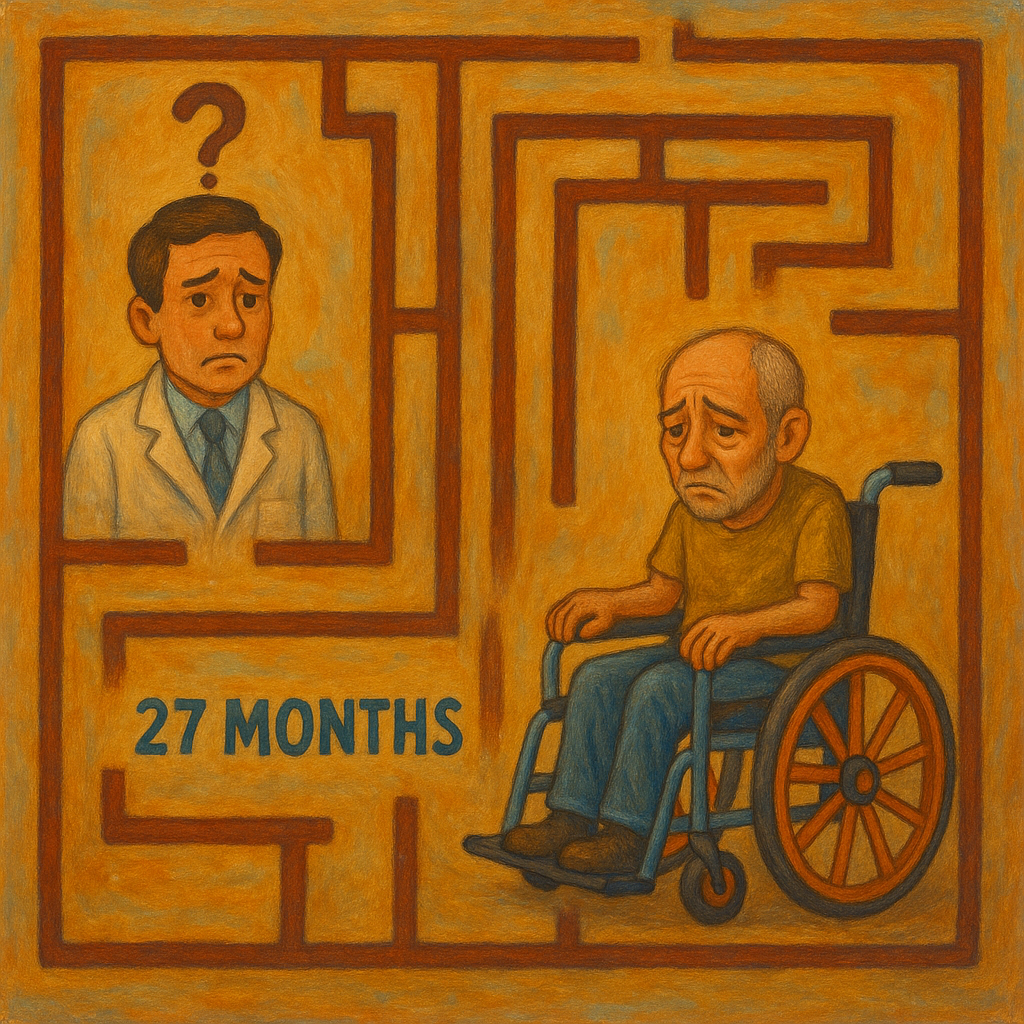
For someone receiving a diagnosis of MND, life can suddenly feel like you’ve been dropped into the middle of a maze—unfamiliar, overwhelming, and deeply disorient-ing.

The thing is, we are not alone in the maze. We know that.  But the others with us in the maze are equally as lost and confusedd.  We bump into all kinds of people wanting to help .  Some don’t even know the name of the maze until we utter the letters MND.

In the heart of this maze, where every turn leads to deeper confusion and the walls close in, there’s no room for chance or instinct—only the desperate need for direction. And that’s where you come in.

It’s not just the body that changes. Identity, relationships, and meaning are all challenged.

What you are doing in developing these guidelines is not just technical. It’s not just procedural. It is profoundly human.

Because in that maze, you are helping us place something like Waze—

Steve and I used WAZE a GPS to drive to Adelaide from Melbourne. It not only showed us the direction but warned us of potholes ahead, traffic congestion, accidents, and police, etc.

Guidelines provide a kind of WAZE a map that helps patients, families, and clinicians navigate an otherwise unpredictable path with confidence, dignity, direction, reassurance, and shared understanding.

And here’s what I want you to hear today:

We place our hope in your ability to produce this work—not just because of your knowledge, but because of your compassion.

Because guidelines, done well, don’t just coordinate care. They affirm identity. They say:

“You still matter. Your life still has meaning. You will not be forgotten or left to figure this out alone.”

You’re not just writing protocols. You’re anchoring people in a story that says:

“Even in the face of decline, you are still a person of worth, deserving of excellence, kindness, and consistency.”

Now let me take this even further.

When someone is diagnosed with MND, it’s like being a prisoner in the American Civil War shown a “deadline”—a literal line that, if crossed, meant death. For us, that line is often drawn at 27 months—the average life expectancy after diagnosis. It’s stark. It’s sobering. And it can feel like a sentence.

But these guidelines you are creating—they take the place of that “dead line.” They redraw the map. Instead of a line of despair, they offer a path of care.

They carry the potential not only to add days to life—but to add life to days.

Who knows how much longer someone with MND may live beyond that 27-month mark?

Let’s find out!

Because those living with MND don’t just need treatment—they need hope.

That hope is not passive —it’s expectant. It’s not just waiting patiently . It’s a confident, eager longing that says,

“There’s still more ahead. There’s still meaning to be found.”

This is the kind of hope people with MND live with every day—not just a hope for cure, but a hope that their care will be consistent, compassionate, and meaningful.

And we are the ones helping shape that hope into reality.

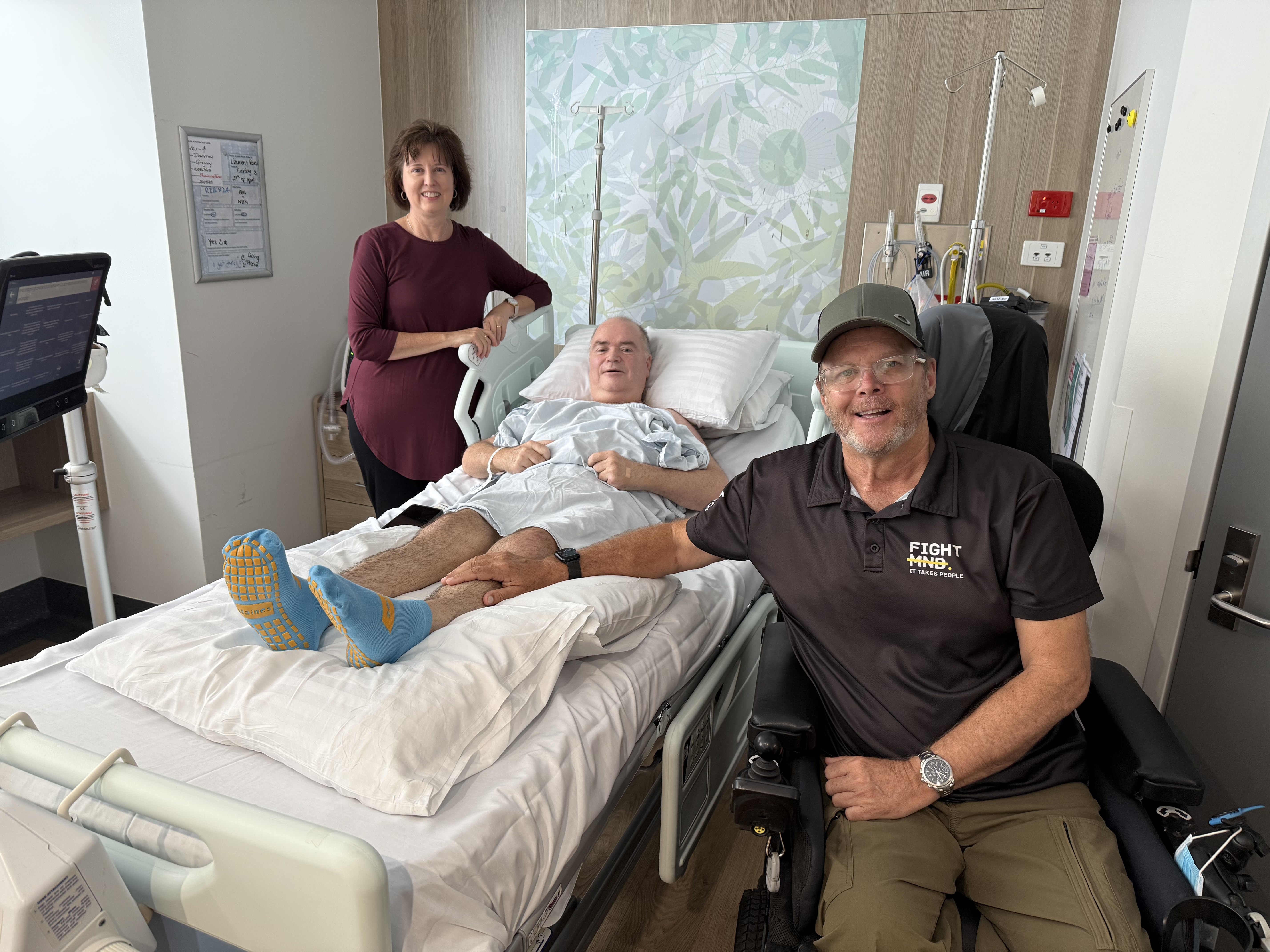
On Tuesday Steve and I visited a friend who also has MND,  Greg is in palliative care and even now the nurse didn’t know how to use a Button PEG – feeding tube. She tried to pull it out and broke it.

Greg is unable to move his legs, arms and cannot speak he is using eye gaze.

He told us that the nurses gave him a buzzer to ring if he needed them but Greg couldn’t push the button. When he got cold and needed a blanket he had to text his wife at home, hoping she would get the text and ask her to ring the hospital and get the nurse to bring a blanket to his room.

So today, as we contribute to these guidelines, know this:

What we are doing matters. Profoundly matters.

You are helping people find their way—not just through systems, but through suffering.

And for that, we are deeply grateful.

Thank you.

Fight MND Roundtable.

Back in August FightMND held its very first Global MND Research Roundtable in Melbourne, Australia. The event brought together those directly impacted by ALS/MND, leading ALS/MND researchers, global collaborative leaders and strategic experts to focus on solving some of the toughest challenges faced by ALS/MND researchers globally.

I was interview about my journey with MND/ALS

Sweet and sour!

Isla James my granddaughter is sweet.

Back in 1973 I was 14 years old living with my mum and sister after mum and dad had separated. To make ends meet financially the three of us would clean the offices of Bruce Lyon Real Estate in Epping NSW.

As a treat every Friday night we would buy sweet and sour chicken and rice from the chinese restaurant. I loved the burst of the sweet pineapple mixed with the vinegar. I have since learned that life is also sweet and sour and we need to learn how to navigate that.

What is the sweet and sour of life. It’s the knowing that we all will live with opportunity, loss, challenges, joys, sadness, triumphs and trials. May I suggest the pineapple was made sweeter in the presence of vinegar.

Thats right every life has its ups and downs, its joys and sadness, its triumphs and sufferings.

I believe we grow more from our moments of pain and suffering experienced in our personal reality than our joys and triumphs.

When you do suffer and experience pain you must discover the path to meaning in the midst of it. Someone once said, “pain redeemed impresses me much more than pain removed”.

I have found that God either removes pain or redeems it (I think He leans more towards redemption). He takes what was meant for temporary evil and turns it around for eternal good.

We can spend a lot of time focused on removing pain when redeeming pain is the way forward and upward.

To find meaning and purpose in pain and suffering is the road to redemption. Meaning gives us the strength to deal with pain and suffering. I would go as far to say, that to have victory in life, meaning is as important as hope.

Hope certainly gives us anticipation for a good tomorrow but meaning and purpose bring joy in the now, in that tomorrow that hope brings us into.

Hope carries us into tomorrows present while meaning and purpose makes sure we find joy in it.

Hope can lift our gaze to a brighter future but meaning focuses our gaze on todays wonder and people.

Hope is a vehicle that carries me into my future while meaning and purpose are the fuel that keeps hope moving forward.

I would go as far to say that happiness is a result of discovering meaning in suffering and pain. Once you allow meaning and hope to pervade every arena of your imperfect existence then happiness and joy will follow. A happiness not dependant on your life being perfect or free from challenge.

For me meaning focuses on three things: pursuing God, personal growth and people ministry. As long as your day has these three focuses then joy can be yours no matter what the challenge. These three mixed with purpose, passion and being present makes for a wonder-filled life.

Pursuing God as a Christian, having a relationship with God through my faith in Jesus means I have a real sense of knowing God and getting to know God as a constant in my life. I am both satisfied and insatiable in my walk with God.

1 John 5:20

And we [have seen and] know [by personal experience] that the Son of God has [actually] come [to this world], and has given us understanding and insight so that we may [progressively and personally] know Him (God the Father) who is true; and we are in Him who is true—in His Son Jesus Christ. This is the true God and eternal life. AMP.

When it comes to personal growth I’m not talking about our physical growth or strength. I have found over the past ten years as my physical body becomes weaker because of the effects of Motor Neurone Disease (ALS) that my spirit man and my soul can grow stronger. This growth in our lives can only come by proper spiritual food, exercise and rest. For me that means feeding on the words of Jesus, meditating on His love, life and light and resting in the peace that comes despite the waves that would crash against our world.

Pursuing God and personal growth has to have an external outflow. What we receive, we must give. We have been blessed to be a blessing. If we have been comforted by God it is for the purpose of comforting others.

People ministry is however not just about spiritual and heavenly endeavours, it also includes practical and earthly pursuits.

I suggest all of our lives, whatever our trade or daily responsibilities, can have a personal meaning and purpose attached to them which will foster significance, self worth, and joy.

As a society we tend to think that people ministry is exclusive to doctors, nurses, fire fighters, police, pastors and the like. It’s true these are significant people ministry jobs.

However, can I suggest that your job is also as significant and an opportunity for people ministry.

Imagine our lives without those who removed our rubbish weekly from our homes.

If your one of those drivers, that early in the morning remove the rubbish from my home, thank you. Your work means so much to me and my family. You help to create a home that is welcoming, fresh and pleasant to live in.

Imagine life without builders who build those homes for us to enjoy family and friends.

Imagine life without a hairdresser, electrician, plumber, motor mechanic, accountant, dentist, retail workers, truck drivers, miners, estate agents, physiotherapist.

Imagine our lives without people who mow our lawns, build our places of recreation, hotel cleaners and public transport workers.

Without a barrister and barista. Without being able to legally drink a coffee.

Without parents who are at home raising children and turning houses into safe and loving homes.

Having made the move from city to country I have come to appreciate the many people who make a steak on your plate possible.

None of us would be able to live the life we live without these and many other people ministering to us in their day to day jobs. Thank God for everyone of you!

Now go out and see that you are not just working for a dollar but you are ministering to a community that is grateful.

What about those of us that have become differently able? Those of us that can no longer do what we used to be able to do.

I believe the key is not wishing that you could still do what you used to do, but look for other ways to express your life values.

For me, with the weakness of my body I need to look for opportunities to share my life lessons with those in my circle of influence.

To be available to those who suffer the pain of been given a terminal illness diagnosis. To be a messenger of hope, faith and love.

As a father and grandfather to cheer on and champion my family who are and will be my greatest legacy and the ones who will have me in their hearts more then any other. To being present for as long as possible to love on my clan.

We all need to look at what we do during the day and attach a greater meaning and purpose to it if we are to find real joy, significance and self worth in our life. If we are to get out of bed with purpose.

May I conclude however in saying that the greatest of joys, the overwhelming sense of being significant and having worth is not in what we can do or who we are, but in the wonder and reality that God loves us and His love is completely unconditional.

Love and peace.

Phil

What I shared at “Belong Women’s Event”. Strength in times of weakness.

MOVING FORWARD WITH LOSS AND GRIEF.

If we love then we will not make it through life without experiencing grief.

Strategies for dealing with grief.


In my last vlog I said:

Life’s beauty is inseparable from it fragility.

The greatest beauty is found in love.  

With love also comes great grief.

If we love then we will not make it through life without experiencing grief.

Living with arms and hearts that embrace life and love will also bring lose.

This loss can be in the form of the death of a loved one, 

Being made redundant from your work place, 

A diagnosis that threatens your life, 

A business transaction that has been lost,

Lose of business that you have given your life to.

A pandemic that separates, isolates and devastates your security and well being.

BUT WHAT if I could show you a way to processing grief and loss that will lead to a greater depth of joy, a new perspective ON life and new purpose FOR life. 

Some real keys to living with and through grief.

First: When we deal with our grief don’t look at it like its a spiralling downward as much as its a way we move forward through pain and challenge.  It’s what Philippians calls the “forgetting what is behind and straining forward”.  

Sometimes going forward means straining and grief is THAT.

JESUS lived for 33 years on this earth and he lived in a way that not one moment or experience he had was wasted or of no value to him or those who would know him.  

In the Garden of Gethsemane we see him grieving again, weeping over his coming death and wanting the comfort of his friends with him. 

In Matthew,: “My soul is sorrowful, even unto death; remain here and watch with me” (Matthew 26:38 ESV).

And, of course, lamenting to God is praying like Jesus did. Jesus prayed a psalm of lament on the cross, crying out “Father, why have you forsaken me?” (Matthew 27:46, Psalm 22:1 ESV).

Jesus grief was seen over the death of His friend Lazarus.

He loved and in His love for Jerusalem, for humanity, for you and I he experienced real grief.

His grief was not wasted neither is our grief.

You may not see any meaning that can be immediately attached to the grief you are going through but the way you go through your grief could in itself attach meaning to it.

This is a world full of brokenness, and grief reveals the truth about that brokenness. 

I think this is a topic again so needed right now more then ever.

It’s a subject that again is 

not negative but positive, 

not destructive but building, 

not disempowering but empowering, 

not weak but strong,

not fearful but courageous.

If we lean into grief the way we should we will bring meaning and purpose to what may seem such meaningless circumstances.

Yes I believe when we see no obvious reason for loss and grief we have the grace and ability to bring meaning to it.

Can I first begin by saying sadness and grief though similar are not the same.

If we think of sadness its not depression and its not grief.

Sadness unlike depression and grief is shorter more temporary emotion we have in lose or disappointment.

When we see that 958 people died in England we are sad but for the loved ones of those who died they will experience deep grief.

Our sadness may only last for a few days or until the next commercial or news report of another tragedy or triumph.

Their grief will stay with them  in some form or another for the rest of their lives.

When I was diagnosed with MND a terminal illness for those who loved me deeply it was a time of grief for others it was sad to hear about Phil.

And thats ok because none of us who love deeply will go through life without grief.

May I also say that grief can have many levels and layers too it.

If your mother was to die at the age of 98 from natural courses your grief will be real but for you to loss a child at a young age to cancer or some other illness or tragedy. May I suggest that grief would be a whole other level and depth so profound that it would impact your life story for ever.

Grief goes deeper, its life changing, its an experience that brings a changed life. 

There is a before and an after this happened when it comes to a life impacted by grief. 

Before this loss and after this loss!

For me it was I was healthy before i was not, with this MND.

I will continue to live, love and enjoy life but life will be different and so will I.

Even if I was healed today my life will never be the same as it was before the diagnosis.

Grief has the ability to make us more loving, patient, compassionate, accepting and gentle.

This will only happen if we face up to grief, truth up to it.

To do this with any sense of truth we have to know that with grief, 

its ok not to be ok, 

until you are ok, 

and you will be OK.

When I lost my sense of self worth and significance after being diagnosed with MND and as a result having to leave a job I not only deeply loved but that I had been called to.  

I loved being who I was and doing what I did so when I lost that ministry as i knew it then my grief was real and tangible.

Grief is not sinful.

It’s  a good and godly response to love and passion lost.

Sometimes we repress grief and try to move through it quickly, or even deny that it is there. 

We might fear that it is a sin to feel this way. 

If we believe it is sin, it follows that we should move away from this negative feeling quickly. 

We fear our grief may cause us to question the presence and work of God in our lives.

What I learned during this time is that it was not the end of me or my life but a continuance of it in ways i never imagined.

I would get up but I would be different.

It was going to be a straining, a stretching,  a reaching but not a breaking.

What i suggest you do in your time of grief is be honest with your feelings and emotions.

Either write them down like no one will read them, so there is no filter by what you should say or be expected to say.

Lament to God as though he is the only one who hears and he knows anyway so your not going to shock Him.

Confide in a wise friend, pastor, counsellor, therapist who you can trust with the truth about how your feeling.

Lamenting to God is a good and holy way to grieve.

Listen to a Lament in Psalm 102:1-2

“GOD, listen! Listen to my prayer, listen to the pain in my cries. Don’t turn your back on me just when I need you so desperately. Pay attention! This is a cry for help! And hurry—this can’t wait!”

 When you write or talk about your grief your showing up to it.

Life is lived when you move forward with your story not by separating yourself from it.  

We become integrated and whole able to move forward in healthy ways.

This week and indeed the months ahead will bring with it sadness for some and grief for others.  

If we are global christians we will not just see the blessing of living in Australia at this time but also feel the pain of what many others in our world are going through especially in 3rd world countries where the news seems to have no concern.

The way we move forward with these real emotions will determine the depth of love, joy and wonder that life is.  

Without grief we would never really fathom the profoundness of love.  

Grief is only possible because we have loved and love is ultimately measured by the depth of our grief.

Grief journeyed rightly, honestly and truthfully will bring new purpose, new direction, new perspective to life.

This new life wont come by ignoring the grief but facing it truthfully and fully until we are change for the better because of it.

So:

 Write it down

Lament and pray to God.

Talk to a friend

Confide in a councillor. 

Remember grief is a stretching, a straining but its a forward movement not a backward one. 

You will be transformed by the experience as you face your grief with grace and truth.

You will find new perspective, new purpose, new love for life and living.

Thanks for listening.  

If your on YouTube why not subscribe to my channel or

 go to my blog at fridayswithphil.com

God bless you all.

A decision not taken lightly

I have made my decision and it wasn’t one taken lightly.

It is with much thought, prayer, research, investigation and hope that I have decided to take a trip to Europe to have some tests and start a trial treatment that isn’t available here in Australia.

It’s not a cure, but it could slow down the progress of Motor Neurone Disease (MND, also knows as ALS) in my body. While I’m doing reasonably well, and have already outlived my initial prognosis, this is the time to act.  It’s a “sooner rather than later” approach.

With ALS / MND, it’s not like you wake up one morning and suddenly you can’t do something.  Instead, little by little, you lose your strength, some people faster than others.  I’m the only one who really notices that decline day-by-day.

In the past 76 years, since the famous baseball player Lou Gehrig was diagnosed with this disease, there has only been one drug approved for ALS / MND patients: Rilutek.  Rilutek was approved in the 1990s and is said to add 2 – 3 months of life to your prognosis.  In some parts of the world this drug costs up to $4000.00 per month.  In Australia, I pay only $37.50.

While I understand that there is more awareness, finances and scientists than any other time in history dedicated to finding a cure for this disease, I also understand that any new drug could take many more years to be released to the general community.  In that sense, the money we are raising now is for the next generation of sufferers.

Some people have inferred that I should just relax and wait for God to heal me.  My thinking is that when your daughter breaks her leg or your tooth needs filling, do you just pray or do you do what you can and leave the rest to God?

I’ve seen God miraculously heal people of cancer through divine intervention and I’ve seen God heal people through medical intervention.  I’ve also seen people experience their healing through entering into eternity.

I have always seen God move in my life when I do my part and leave what I can’t do to Him. 

Faith, trust, rest and hope are not couch potatoes, they are active and courageous as they approach the battle.

So for those who are praying, thank you, your prayers are effective and mean the world to me.  Be encouraged, I am also doing what I can do to partner with your prayers.

My treatment in Europe will cost in the many thousands of dollars per year, but it has also been known to add 3 – 4 years to a patient’s life.  Next week I go to Europe, hoping for the best, mainly because I want what you would want in my shoes:

I want more time with my wife.
I want to see my grandchildren go to school.
I want to be around long enough so they have some memory of me.
I want to hug my own children for as long as I can.
I want to be around to cheer them on in their lives and adventures.
I love this life.
I want to finish the race at the finish line, not mid-field.

And so, Fridays With Phil will take a short break. If you are interested in updates while I am away and post-treatment, you can follow me on Instagram (@pcamden) or Facebook.

I covet your prayers over this time,
Phil

Blog at WordPress.com.

Up ↑